Profile: artist

Sam Firth

Sam Firth, 'I.D.', film still

[enlarge]
Sam Firth, 'I.D.', film still

Sam Firth, 'I.D.', film still

[enlarge]
Sam Firth, 'I.D.', film still

Sam Firth, 'A still from the film Stay the Same  - 3 September'

[enlarge]
Sam Firth, 'A still from the film Stay the Same - 3 September'

Sam Firth is currently working on a year-long video project on a remote Scottish peninsula near her home on Knoydart, an isolated community of just over 100 people. She talks to Andrew Bryant about personal narrative, securing funding and recent media criticism attracted by her current project.

Andrew Bryant: You seem to be interested in the human face and the passing of time. Before we talk about Stay the Same could you speak a bit about your previous projects?

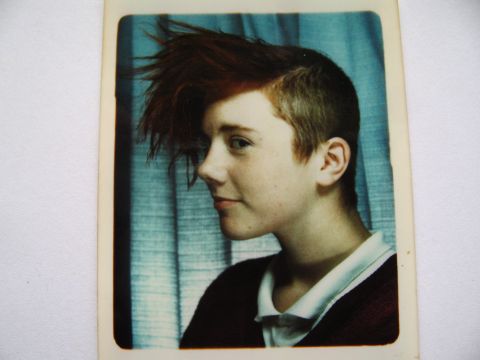
Sam Firth: I'd say, it's not so much the passage of time I am interested in but our relationship with the camera as a way of exploring personal narrative. My first two short films do this in different ways. I.D. explores my teenage years using the relationship I had with the photobooth turning a collection of over sixty photos I kept from the period into a narrative. The Worm Inside uses the more immediate form of video diary to explore a failed attempt to give illness a positive and even heroic narrative while it was happening. 

While making The Worm Inside I found that the recordings where I was silent had far more emotional resonance which is why I decided to document an emotional journey without words in Stay the Same.

AB: Tell us about Stay the Same - where did the idea come from? How difficult was it to get the ball rolling, to secure funding and permission?

SF: The idea for Stay the Same came out of the same period of illness as The Worm Inside. I became far more aware of my own mortality and the limitations of time during this period. The illness also produced some quite radical physical changes which at first was what I wanted to document. It took a while to realise it was much more about trying to capture and hold on to experience, to preserve time.

I started by making a test film over a few weeks and actually shelved the tapes for quite a while. It was only when I went back to them about six months later that it became clearer what I was trying to do.

By this point the UK Film Council had picked up on my work at festivals and indicated that although funds were limited if I came up with a strong proposal for a new piece of work they might be able to support me in some way.

Writing the proposal took several months and I used this time to test the light in the winter months as I knew I wanted the film to go through a period of darkness.

AB: What was been the cost of this project - both financially and emotionally, in terms of time and commitment?

SF: It's almost impossible to quantify this. I did have the idea at one point of recording the hours I've spent on the film, but this in itself would be a time consuming exercise. Ultimately however, whatever the costs have been, by the end of the project I think they won't be as much as I will have gained.

It has been emotionally quite difficult at points knowing that I can't leave and I have had to turn down quite a lot of freelance work elsewhere but the film has given me an incredible opportunity to work on new projects and ideas and explore my practice as a filmmaker that I wouldn't have had otherwise.

AB: In one of your early blog posts you talk about the trend for daily self-portraits that proliferate on the Internet. You speculate as to what drives them, asking, "Is it narcisissm? Curiosity? A fixation with ageing and mortality?" Having now spent a year on one such video yourself, what conclusions have you drawn?

SF: It's interesting, before I started filming I hadn't made the connection between my film and the photo everyday films on YouTube and I maybe gave ammunition to those who've criticised this project by doing so, but I do find it fascinating.

I see YouTube as like the modern equivalent of a Victorian travelling fair. It is a place of satisfying curiosity and novelty. This is not to denigrate it in any way as the invention of cinema came from the same motivations and the things we are curious about say a huge amount about us as a culture.

We do seem to be obsessed with ageing and at the same time in denial about death. We are also obsessed with recording and documenting our lives, possibly for the same reason.

Most human thought, ideas, science and art is fuelled by a desire to understand ourselves and our place the world. Mostly I think this stems from a genuine desire for self knowledge, but we all have the capacity for narcissism. Differentiating between the two, particularly in oneself is not always easy. Having a psychotherapist as a father has a lot to answer for!

AB: Your no-nonsense title Stay the Same, which reflects the slow pace of life on Knoydart, could be read as a protest against today's accelerated culture. It might equally be a prayer, a mantra, to ward off ageing and mortality. In what way does your video speak to contemporary society?

SF:One hopes as a filmmaker to make work that says many things to different people. Ideas of accelerated culture, ageing and mortality are of interest to me so I hope they will be present in the film. But you can only really discover what a film is saying once it has an audience. To try and do this before it is finished would negate the need to make it at all.

What I have found though, which is why I started collecting responses using my blog, is that the process itself has prompted some very interesting reactions and thoughts on a whole range of issues.

I hope the final film manages to express even a few of these ideas and others I have had over the year, but as a piece of work it is an experiment and I have to be prepared for the possibility that it may end up failing to say anything at all!

AB: In a recent post you reflect on the fact that you are trapped for a year on "the most remote peninsula in Britain", an insight that reveals the isolation that paradoxically attends any attempt to escape modern life. How important has your blog and twitter been to you in communicating to the outside world?

SF: Creating a blog as part of the project seemed a natural progression of it and my relationship to the internet has changed over the course of the year as a result. I'd say I have a love hate relationship with it. It's been really useful as a platform for gauging people's response to the project and understanding of the ideas behind it and there is a sense now that with the Internet there is no such a thing as remoteness or isolation.

In terms of actual communication however, the telephone and having visitors has been far more important. The Internet gives an illusion of connection whilst having the capacity to be incredibly distorting. It puts you and your interests at the centre of the universe at the exclusion of all others which isn't necessarily very healthy and there is far too much space for misinterpretation and fantasy.

AB: Reports in The Telegraph (see www.telegraph.co.uk) and Scottish editions of The Daily Mail and The Sun criticized Stay the Same, suggesting that you were receiving £160 per hour of public money for standing still next to a loch. What do you make of this negative reaction to your work?

SF: It's been really interesting. The reports were almost certainly an attempt to stir up controversy and create a debate about public funding for the arts. Fortunately most people saw it for the silliness it was and it didn't turn into this. But it was a reminder that this is precarious time for public arts funding and generally for any creative practitioners.

On a personal level, it was quite odd to suddenly find my work scrutinized in the national press, especially given my location and background as a short filmmaker. There was a sense of the project being reduced whilst at the same time elevated in status and it has generated interest in my work.

What was written, the discussions I have had and articles I have been asked to write as a result have prompted me to re-examine my ideas and given me renewed focus at a time when it hasn't always been easy to sustain. 

AB: The shooting of Stay the Same will come to an end in June 2012. What are your plans for the video once it is complete?

SF: The film won't be finished until the autumn and again some of this depends on the nature of the final film. In the past I have taken the conventional root of screening my short films at film festivals before making them available online as many festivals won't screen them otherwise. However, because the Internet has been so central to the project and because of the interest I have had in it I am considering the possibility of trying to create an online 'event' for the film making it available for a limited period, but I won't know this until much nearer the time.

AB: A year spent on one video is a big commitment. Have you been hatching plans for the next idea?

SF: Part of my original funding proposal for the project was that I use this time to develop this and other pieces of work which I have been doing. I am currently writing a screenplay for Digicult and Creative Scotland for a feature length drama and am also developing a feature length experimental documentary exploring the creation of personal narrative through family and childhood memories which is being developed through the EIFF Network Scheme. One of the most useful pieces of advice I've been given as a filmmaker is to try and always have at least three pieces of work at different stages of development, which is something to aim for at least!

staythesamefilm.com


Andrew Bryant

Andrew Bryant is an artist and freelance editor living in London

andrewdbryant@gmail.com

First published: a-n.co.uk March 2012

Post your comment

No one has commented on this article yet, why not be the first?

To post a comment you need to login

©  the artist(s), writer(s), photographer(s) and a-n The Artists Information Company
All rights reserved.
Artists who are current subscribers to a-n may download or print this text for the limited purpose of use in their business or professional practice as artists.
Parts of this text may be reproduced either in accordance with the provisions of the Copyright Designs and Patents Act 1988 (updated) or with written permission of the publishers.