Page 1 of 1 :

  • 1

This project blog »

Bookmarks

Other blogs by Steve Joyce

Feedback Feedback

Inappropriate material?
Ideas? Technical issues?
» Feedback to a-n

Project blogs

Un-Fiction Snapshots etc

By: Steve Joyce

This blog traces the continuing development of two projects begun during my recent Masters degree.

Questioning the nature of objects, images and experiences, I am interested in the unreliability or inconsistency of images and meaning, and how we might or might not expect to find things.

Key concepts are intertextuality and indeterminacy and research follows the writings of theorists including Barthes, Eco, Burgin, Derrida, Owens and Virilio.

click to expand/collapse 

Steve Joyce, 'Hand Cut', Cut photograph, 2013.

[enlarge]
Steve Joyce, 'Hand Cut', Cut photograph, 2013.

Steve Joyce, 'Digitalised Snapshot 1', Cut Photograph, 2013.

[enlarge]
Steve Joyce, 'Digitalised Snapshot 1', Cut Photograph, 2013.

# 10 [19 May 2013]

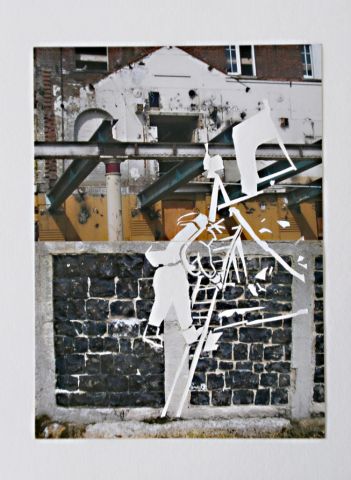
The digitalising and pixilation continues. I have been working further with the pixilation ideas and this time with combining the snapshot ideas to produce images that refer and defer in different ways within the same image. I created a grid template derived from the 1cm square increasing in size at regular intervals to restrain the drawing aspect of the cutting and enforce the 'neutralising' affects of the technological age. While the squares which form consistent captures of the scene, the defined cut out element (a hand in this one, Digitalised Snapshot 1) signify in a more specific way. The two aspects complement each other as the context is built in the way they both refer outside of the photograph, yet the particular signification of the place is denied and diverted around in an unsettled representation that resists closure (this is a 10 x 15cm snapshot photograph).

I have also been cutting out larger photographs. This one (Hand Cutout) is A4 size and seems to work well on a larger size, though I am not sure where this one is going, but I did return to it and enclosed a 1cm square just below one of the hands, which seems interesting. I think that the pixel on a larger scale works differently and has some potential, so I will work on some more pieces.

Steve Joyce, 'Pixs 2', Cut photograph, 2013.

[enlarge]
Steve Joyce, 'Pixs 2', Cut photograph, 2013.

Steve Joyce, 'Pix 1', Cut photograph, 2013.

[enlarge]
Steve Joyce, 'Pix 1', Cut photograph, 2013.

Steve Joyce, 'Pix 4 group', Cut photograph, 2013.

[enlarge]
Steve Joyce, 'Pix 4 group', Cut photograph, 2013.

Steve Joyce, 'Pix 3', Cut photograph, 2013.

[enlarge]
Steve Joyce, 'Pix 3', Cut photograph, 2013.

# 9 [6 May 2013]

Researching put aside I have been making work like frantic and now it is time to start up loading the progress.

I am working on multiple ideas at the moment with work in progress for collages, drawings, installations and more printmaking. This is because I am rationalising my time and also to meet oncoming deadlines and keep the different projects running to the right development needs.

These photocuts are a progression of an idea that developed a while ago and takes a while to work towards completion as the piece needs to be a lot bigger yet. Taking up Virilio's ideas about the technological age and issues of image saturation in the technological age, these images (snapshot photographs) are reduced to the decimal 1 cm square taking a consistent top-left intrusion as the motif in the reduced image left from within the picture. The origins of the pictures are obscured by the reduction as the surface is peeled away to leave these recurring, abstracted, motifs from within the photograph, nullifying and multiplying the insistent noise and torrent of fleeting images, lost as they are in a nondescript expanse. The working title is Pix, as a play on . . . well you can guess, I guess.

The work seems to be moving in the right direction and plays a similar game as the earlier installation View Points that I completed last year (see my website portfolio), but here it centres on a sense of lost or dismay rather than the familiar expectations of encounter afforded by viewing points in the landscape as before. The viewer here has to scrutinise in a vain attempt to work out what is being depicted. It seems at the moment that the piece must be considerably larger to impact on the viewer significantly.


Steve Joyce, 'Tracing the Everyday 1', screen print, 2013.

[enlarge]
Steve Joyce, 'Tracing the Everyday 1', screen print, 2013.

# 8 [7 April 2013]

I have been busy with mounting, framing and preparing work for exhibition, as well as producing artwork, though not documenting much. I have work selected for the Suffolk Showcase, Smiths Row in Bury St Edmonds and work also on exhibition in The Foyer, University Campus Suffolk, Ipswich in the Atrium Studios Members exhibition. I met some nice people along the way and also at the Airtime Event at TAP, in Southend earlier this week.

So now back to reflecting on the work. Keeping with the everyday, the traces, and the index, recent work has taken another turn. The Snapshots series took a pre-existing object, the found photograph as a foil for allegory and an index from the everyday investigating representation. The new work takes another item from the everyday as a foil for allegory, the doyley is another tradition steeped in history and associations, and perhaps also an endangered object like the printed snapshot photograph which is in decline. The first of the new series of work is Tracing the Everyday 1, pictured here, a screen print A3 size.

The process of cutting and removal of material is the same as before but the resulting altered form is dispensable. As it is merely the masking to produce the screen print it has fallen into obscurity. It has not been retained or retrieved from its own obscurity, but exists as a copy in the short run of prints. 'A copy now without an original' which brings my thoughts back to research on Deleuze and Baudrillard, so it has taken the steps of cut and removal a step further. I printed it with a single colour emphasising the process and the index back to the absent object, which I feel contradicts or denies the image to some extent, or perhaps makes it problematical in as far as we might read into it and yet it obstinately refuses to reveal the connection in any really secure way. I have had some positive feedback already and it seems to function in the intended way as it hovers between ornament and image, mass cultural reference and fine art object.

I am still working on the rest of the series, but have been coming across critical writing that positions the process of making in the Tracing the Everyday screen print series in a place I had not expected. Well not entirely. Ward's book on postmodernism that I had been reading also explores Warhol's work because of the low and high culture of mixed processes of painting and print and because of the content in the representation and its abstraction, and the distinction of original and copy. This he situated in relation to Greenberg's modernism as a departure, or as he puts it a confusion. Hal Foster's Return to the Real discusses similar issues in Warhol's work as I have just started reading, and this is all very interesting and revealing. Back to Ward and the connection back to Dada; he states an 'attempt to reconcile art and everyday life' exists in Warhol's work and in postmodernism. I can see that, but I am not convinced that the line of enquiry should be left there, as I think that there are wider considerations and issues here. The origins of the images and the processes involved collect with them contexts within which to read them, and yet also outside of that they create an engagement in the work that is about something else.

I am not quite sure what that means, exactly, but it lies in the area of interpretation and issues of authorship and intertextuality. If my work operates in similar ways, then that makes sense as those are issues I have brought into the work. I like the precarious allusion to distinctions of high and low culture, and clearly I set out to play on that mass/sub culture skull and pattern and pink aesthetic, but I used the method to try to restrain any indulgence in the genre, the process states itself very directly. The work is not to reconcile the art to the everyday, but to bring the trace out from the everyday; and through the use of process and material to interfere with expectations and to push the representation back on the viewer. It both confirms and denies what it is.

I think I better leave it there for now.

Steve Joyce, 'Photoshoot 3', Cut photograph, 2013.

[enlarge]
Steve Joyce, 'Photoshoot 3', Cut photograph, 2013.

# 7 [22 February 2013]

The problem with theory is that the more that is read, the more thoughts, connections and ideas are brought to mind, but then again that is great. And I guess a contradictory statement typical from me to make to start this post.

Some overlap to start with. The Aesthetics book opened discussion about metaphor, which I felt, was not a consistent aspect in my work, but none-the-less interesting. He said in the later section about expression something that occurs in the metaphor section. He distinguishes here between private and public again, in so far as he explains how there is a difference between a persons' felt emotion and expressed emotion. There are two aspects private and public, and before in the metaphor section it was established that metaphors are public significations, agreed over time by others. And so, this is an aspect in my 'Snapshots' work, in that family snaps are private in terms of being personal records (or particular) and yet are public as they follow (universal) conventions agreed over time by others. Then again Ziki discerns two types of memory, episodic and semantic; so we could say that episodic is private or personal in some way, and as for knowledge about the world (the semantic), well that has got to be public as it derives through others. Hmm. . .

So does that lead us anywhere? Well, between reading back over some Rosalind Krauss notes and reading a new book on postmodernism going over Derrida's différance and deconstruction and so on; and I guess Heidegger's term 'language speaks us', there seems some consistent relation between some of these theories and the work in progress.

Krauss tells us that the 'index' and the 'means of production' are key to the postmodern work of the seventies and the photograph as index is central; and explains that there is a link back the readymade of Duchamp. This makes sense as I am using photographs particularly because of their index and because they pre-exist my interventions. The work has some grounding in some of these poststructuralist ideas regarding the means of deriving meaning, and so I think the work has to engage in an exploration the relation between individual and collective, so the public and the private are relevant opposites to explore. And this is a relation that come up in different ways the more I read . . . well along with other stuff.

The point is that the 'Photocuts' that I have been creating turn the index into symbol, the particular into universal, and therefore the private or personal into the public (i.e. conventions of language) in some way. The nonsense or humour that creeps in is both my playfulness and a means to engage others into the deciphering process. If Krauss fixes the index in the postmodern then my work in progress is not maintaining that approach as I continually move away form or transpose that index. So I am working in relation to these ideas rather than dependant on them.

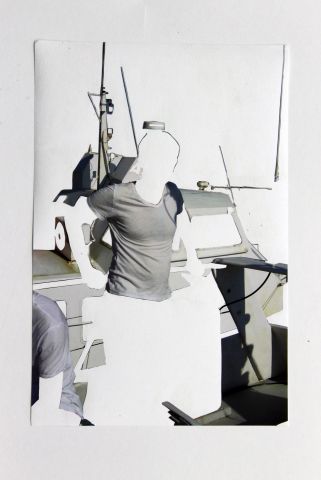
The latest piece is again hinting at narrative in Barthes terms as in the last blog post, but here in Photoshoot 3 the remains of the photograph pictures signs that could build a context differently to the last piece, in that the arm is a potential 'actor' but the gun and shawl add more connotations than a potential part to play later on, and yet still the image hovers unfixed as intended. Perhaps there is something of the 'empty signifier' in my work, that Krauss also discusses in her essay as she describes Jakobson's 'shifter' in terms like 'this'. Well, in as far as it does a similar thing, by pointing to a possible reference, context or narrative without fulfilling the whole story. I think I will research this more as this is also interesting. That's it.

steve Joyce, 'Photoshoot 2', Cut Photograph, 2012.

[enlarge]
steve Joyce, 'Photoshoot 2', Cut Photograph, 2012.

# 6 [27 January 2013]

Well my website is finished and uploaded on to the internet, finally. whoop, I think is the expression.

So moving on from Barthes 'cardinal' functions in narrative, the uncertainty aspect is clearly central to the work I am developing, and after reading through passages in a book on aesthetics I notice other moments of uncertainty operate in language.

In discussing metaphor in Aesthetics, Dickie argues around the assertions of Beardsley and his 'object-comparison' view, which he refutes, and discusses this in relation to Aristotle and the 'widely held view . . . metaphor is a disguised simile which makes an implied comparison'. He also discusses an example as an 'open simile' in which we are left to work out the context. This later point seems to make more sense on the face of it, than Beardsley's argument but as Dickie says later, metaphors do not 'refer' as such, and therefore if we are to talk clearly about metaphor we should avoid talking about signification on those terms.

What he seems to be alluding to is shifting context as the key and also that the meanings are derived from different origins, which are not definitions. So simile and the object need to stay out of the argument.

From here, in terms of metaphor and also in terms of narrative and cardinal functions, a sense of movement, displacement, uncertainty or deferring operates which creates an expectation or addition to what is expressed. The meanings are not literally evident, but there may be possible available associations. There is something significant concerning this moment of uncertainty.

The most recent piece I made Photoshoot 2, pictured here, suggests the full picture yet hovers in anticipation. Hmm, interestingly moving to a new approach . . .'

The Snapshots photocuts held quite firmly to the genre of family photographs and Un-Fictions cut books interestingly played with what my reading of Ziki describes as a difference between semantic memory and episodic memory, the latter being what you know from your own experience; but the Photoshoot series is different as I have no associations with the images but they do not have cultural associations in the same way. Narrative expectation overrides metaphor in the new work, and I may not be 'refering' either, but representation here is taking the viewer somewhere else.

There is something in all this that makes (or may make) sense somehow, and the journey finding out is interesting.

Steve Joyce, 'Photoshoot', Cut Photograph, 2012.

[enlarge]
Steve Joyce, 'Photoshoot', Cut Photograph, 2012.

# 5 [1 January 2013]

The movement from Snapshots to the new batch of found photographs, the Photoshoots, marked a change in my approach to the photographic image. Here the red-screen 'arena' was identified, which set the focus on that area which defined the posed subjects, instead of framing the composition with the outer edges of the photograph; which defined the 'cropping' nature of the Snapshot pieces.

This idea of 'arenas' where the posing takes place occurred in earlier Snapshots, is generating further ideas, but one image in that set of photocuts has a very different character. The last Photoshoot piece did not so much outline as isolate. This occurred in my earlier photocuts when the focus was more singularly on suspension of closure. Yet in this Photoshoot piece there seems a sense of narrative, although not clearly defining a particular narrative. The isolation of the parts of the subject has moved away from signification and connotations to function differently.

I have been reading an essay called An Introduction to the Structural Analysis of Narrative by Roland Barthes which explores conditions that dispose language to narrative. Barthes distinguishes three levels in narrative work: 'functions', 'actions' and 'narration'. He talks about functions as elements that 'will later come to maturity' which are distributional. These elements create 'operations' as 'cardinal' functions 'that either initiates or resolves an uncertainty'.

I am not sure that we can attribute these principles to my work as a particular narrative is not being sort in the work, but there is an implicit expectation at work. The 'uncertainty' is evident and this anticipation has parallels with Barthes discussion of narrative structure in some way. Even as a catalyst for ideas the theory informs the work and this Photoshoot piece is a starting point for further adventures into picture making.

Steve Joyce, 'Snapshots', cut photograph, 2012.

[enlarge]
Steve Joyce, 'Snapshots', cut photograph, 2012.

# 4 [17 December 2012]

So thanks to Jean I have read Family Snapshot by Spence and Holland, and see the relevant points that relate. Patrician Holland identifies that snapshot collections only include 'approriate' or 'significant' photographs, and so 'family albums are about forgetting as well as remembering' and that reflects my ideas for photocuts. The further comments Holland makes are of interest for some of my other developments, as she notes that 'political change is embedded, rarely visible on the surface' and also quotes from Wright (1983), 'but the evocation is of "precious and imperilled traces" against a speeding-up of time and the all consuming power of technology'. The last point really echoing ideas about the remoteness and distancing of our technological age that my snapshots installtion was exploring, and brings Virilio back into view. An interesting read, and Annette Kuhn in the book says ' . . . the past is made in the present.' alluding to the collectors' construction of events through selection which can relate to Holland's 'really visible' events outside of the family concerns and maybe ideas yet to be developed?? Where the two aspects come together?? . . . Hmm? There are some converging references here and some rethinking perhaps, in that other re-presentations could arrise. Hmm.

Steve Joyce, 'Photoshoots 1', Cut photographs, 2012.

[enlarge]
Steve Joyce, 'Photoshoots 1', Cut photographs, 2012.

Steve Joyce, 'Photoshoots 2', Cut photographs, 2012.

[enlarge]
Steve Joyce, 'Photoshoots 2', Cut photographs, 2012.

Steve Joyce, 'Photoshoots 3', Cut photographs, 2012.

[enlarge]
Steve Joyce, 'Photoshoots 3', Cut photographs, 2012.

# 3 [21 October 2012]

Thanks Jean for your comment, I have ordered a copy of the book already, sounds interesting. Seen an interesting reference on Claire Manning's blog too, so post MA progress is about more research, but that is good I am thinking.

As for progress with the newly found photographs of photoshoots, well, it kinda started from where I left off, Photoshoots 1, in that the poses and compositional aspects were identified with obvious focus.

But then the wider studio shots with the red-screen as part of a room seemed to create a different response, Photoshoots 2. The screen is intended to function as a neutral, to separate the figures from the context, but here it seems to in fact emphasise that process of situating the focus. Not sure that makes sense as I am trying to find the words, but the part normally cut out (red-screen) remains here and the subject is absent, and that seems interesting.

Photoshoots 3, are the best pieces so far and the more ambiguous the better I think, as it forces the looking, it forces anticipation. Not sure where next, but representation is not familiar here but it is implied, and seems different, there is a certain uncertainty that is 'un-ordinary' and yet there is nothing to sustain the idea that it is exceptional to the ordinary. Contradictory yes, intriguing perhaps, but it does follow my interests in the viewer's role in signification. Hmm.

Steve Joyce, 'Snapshot 26', Cut Photograph, 2012.

[enlarge]
Steve Joyce, 'Snapshot 26', Cut Photograph, 2012.

Steve Joyce, 'Snapshot 17', Cut Photograph, 2012.

[enlarge]
Steve Joyce, 'Snapshot 17', Cut Photograph, 2012.

Steve Joyce, 'Snapshot 13', Cut Photograph, 2012.

[enlarge]
Steve Joyce, 'Snapshot 13', Cut Photograph, 2012.

# 2 [14 October 2012]

The Snapshots series continues, but it started with a shift from cutting and peeling 4 x 6 inch photographs to leave only singular objects that could be juxtaposed with other such cut-outs to create 'plausable' images collaged together.

Snapshots focuses on the compositional arrangements inherent in such images. There is a certain familiarity and universality to the images that speaks of the ritualistic marking of time, the restating of family ties, rites of passage and also the incidental capture of off-hand moments of the everyday.

Researching the photographic image Roland Barthes identifies 4 messages at work in photographs. So as I found myself separating the symbolic image from the denoted, as I removed the indexical trace from the photograph as I cut and peeled the surface away, the focus on cultural conventions comes to the fore. Snapshot 26 signifies objects that are part of celebration while the posed figures grouped together enforces that universal ritual. Snapshot 17 puts emphasis on the mundane as an off-hand moment is captured in a familiar un-posed composition. Snapshot 13 oddly enough perhaps reveals the incidental while all present in the group pose for the ritualistic recording of family, the foot insists on having some attention.

So the project is a sincere exploration yet also playful in approach. I have found some posed photographs by others of fashion shoots and the like, which I am currently working on, which set different conditions as a starting point. So it maybe that some consistent differences will arise from that. We shall see.

View comment icon View 1 comment »

Comments on this post

Hello Steve, I'm really pleased to have stumbled upon your blog. I'm very intrigued about your explorations around snapshots. What jumps out despite the elimination of most of the image, is the recogniseability - as you say, familiarity of the snapshot. It reminds me of how tight, and rigid the conventions of this kind of photography is. I'm very interested in the cultural meanings of family photography, and have read some very good writing by Annette Kuhn and others on the subject in 'Family Snaps: The Meaning of Domestic Photography' which you might be interested in. I will be interested to see how your interventions into the posed photographs compare with the snapshots!

posted on 2012-10-14 by Jean McEwan

Steve Joyce, 'Snapshots', Cut photographs, 2012.

[enlarge]
Steve Joyce, 'Snapshots', Cut photographs, 2012.

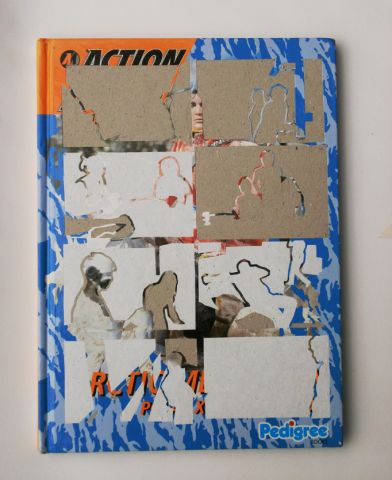
Steve Joyce, 'Un-Fiction 1', Cut Book, 2012.

[enlarge]
Steve Joyce, 'Un-Fiction 1', Cut Book, 2012.

# 1 [22 September 2012]

The starting points for further defining and developing my post-MA art practice are the two project ideas: 'Un-fictions' and 'Snapshots'. Informed by diverse theoretical research, the central concerns are the conditions and problems of representation and meaning.

Drawing on the concept intertextuality (what the viewer brings to the image from previous knowledge and experience) and considering the underpinning differences between images that derive from our own experience or remotely from other sources, the question leading the work is, what is the quality of that encounter? Or put another way, what is the significance of the interpretation? Hmm, curious.

If our Episodic memory is formed from our personal experiences and our Semantic memory is sourced from other knowledge of the world that we may have no direct experience, then the meanings offered by these different perspectives may produce varied meanings when encountering images. Hmm, fascinating.

I play with the conditions, references and significations indicated by appropriated images, objects and printed materials to explore these complexities and contradictions. Enjoy the uncertainty and discrepancies.

Snapshots explores representation of memory in family photographs (snapshots).

Un-fictions is the more recent series of work which explores differences between image and object, where the remote images is 'grounded' in an object of a more personal experience.

Page 1 of 1 :

  • 1

This project blog »

Steve Joyce

I am an artist and lecturer who works both independently and collaboratively on arts projects. I have recently completed my Masters degree at Colchester Institute and continue to explore and develop my practice. Appropriation and collage are central to my work and currently printmaking is an area of development I am exploring further. Some of my work can be seen on: www.axisweb.org/seCVPG.aspx?ARTISTID=13054 www.a-n.co.uk/link/steves-blueprint www.play43460.blogspogspot.com

www.stevejoyce.co